El techo del prohibicionismo: crónica desde la Expo Cannabis 2026The Ceiling of Prohibitionism: A Chronicle from Expo Cannabis 2026
Desde Jujuy a Buenos Aires, Mariano Benitez fue parte de la Expo Cannabis 2026. Recorremos lo que dejó la cobertura especial de La Rama que Llama para Revista Hierba, un encuentro que reunió a la comunidad cannábica argentina y donde se escuchó: «No más presos por cultivar».From Jujuy to Buenos Aires, Mariano Benitez took part in Expo Cannabis 2026. We look back at La Rama que Llama's special coverage for Revista Hierba of a gathering that brought together Argentina's cannabis community and where one cry rang out: "No more prisoners for growing!"
Por Mariano Benitez · 8 de noviembre de 2026By Mariano Benitez · November 8, 2026
Especial desde Buenos Aires para La Rama que Llama / Revista Hierba
En lo que fue mi visita a Buenos Aires, después de un largo viaje desde Jujuy, tuve la sensación de llegar a una gran estatua del tiempo: inmutable y majestuosa. Respecto a lo que me compete sobre mi visita, el objetivo fue asistir a la Expo Cannabis 2026, realizada los días 23, 24 y 25 de octubre, con acreditaciones confirmadas. Sentí esto como un reconocimiento a los años que lleva La Rama que Llama como programa de radio cannábico al aire.
Al llegar a La Rural —un gran predio en el cual se realizó la Expo Cannabis y, en otro sector, una muestra de autos de colección—, me encontré con un edificio gigante que albergó más de 100 stands. En ellos se podían encontrar consultas médicas y veterinarias; observatorios de cáñamo con alimentos, textiles y máquinas; y el observatorio de plantas de cannabis, donde una era más linda y olorosa que la otra. También había un sector de bienestar con venta de productos para la salud y un sector dedicado a la ciencia con las investigaciones y descubrimientos del año, espacio gestionado por la Red de Cannabis de Uso Medicinal e Industrial del CONICET (RACME). Además, funcionaban tres grandes escenarios donde se podían apreciar las charlas de expertos en la temática.
Recorriendo cada pabellón (palabra un poco rara que usaron para nombrar los pasillos), pude ver la industria en funcionamiento: stands de venta de luces, flores para personas con REPROCANN, semillas, dispositivos de riego hidropónicos, fertilizantes orgánicos y toda la parafernalia básica y top para el consumo de cannabis de diferentes formas y con distinto impacto en nuestra salud. El lugar explotaba de gente subida y con ganas de subirse a la ola de la marihuana; luego, un patio reunía a todas las marcas que forman parte del mundo de un usuario de la planta en cualquier parte del país.
En cuanto a las charlas, se dieron sobre diferentes temáticas: otras plantas medicinales, estudios legales e investigación científica. También estuvo presente el reino fungi en un stand y observatorio al cual era muy difícil acceder porque siempre estaba lleno (es la nueva alternativa medicinal que se viene en la comunidad).
Luego, después de una lluvia siempre amenazante, salí al patio, al aire libre, a ver a la comunidad que se desenvolvía ante los ojos exorbitantes del centinela del viejo edificio de la Sociedad Rural.
Había sabores, olores y colores de todo tipo, donde la premisa de compartir era la que mandaba. Luego de pasar por un stand donde sahumaban a los asistentes, arrancamos la caminata por el gran patio, en el cual había puestos del INTA, un espacio exclusivo para el tratamiento del autismo, la carpa THC —donde se daban charlas sobre cultivos y actividades recreativas— y todas las grandes marcas de la parafernalia cannábica. En estas últimas se realizaban juegos por semillas y merchandising, generando grandes filas para participar. El patio de comidas contaba con food trucks de grandes marcas de comida rápida. Cabe mencionar en este momento a Highlander | Asociación Civil, ONG de San Luis que llenó de humo los pulmones de quien pasara por el patio, ya que su stand se encargó de compartir una cata permanente de flores.
El lugar que tuvo la ciencia
El INTA estuvo presente exponiendo el cáñamo como una alternativa ecológica y amigable para la construcción y el uso de fibra. También expusieron las dificultades con las que se encuentran hoy debido al desfinanciamiento y desguace que sufren los organismos del Estado, junto con los profesionales a cargo de las investigaciones sobre la planta dentro del CONICET.
Se realizó una exposición y premiación para los pósters de investigaciones en Ciencias Médicas, Ciencias Veterinarias, Ciencias Agrarias, Ciencias Jurídicas, Ciencias Sociales, entre otras. En la premiación final, el presentador destacó que el área social fue una de las que más trabajos recibió este año. Uno me llamó particularmente la atención: un trabajo de la ONG Oeste Cultiva Moreno junto a la Unión de Excombatientes de Moreno, titulado “Cannabis medicinal y salud integral en veteranos de la Guerra de Malvinas y sus redes familiares”, realizado por la Lic. Iara Peralta Brites y el Dr. Daniel Fernandez, de quienes hablaremos en otra nota. Al momento del reconocimiento, cada investigador premiado pidió vehementemente que se cumpla la Ley de Financiamiento Universitario.
El techo del prohibicionismo
El título de que la Expo Cannabis es “el techo del prohibicionismo” surge justamente de un parafraseo de la charla magistral del Dr. Marcelo Morante, referente en medicina y políticas públicas en relación al cannabis, y de la última charla a cargo de Adriana Funaro y Matías Faray, reconocidos militantes y activistas de la comunidad cannábica. Fueron ellos quienes esclarecieron esta frase: “El prohibicionismo y la Ley 23.737 de Estupefacientes le ponen el techo al desarrollo de la industria, la salud y la ciencia”, ya que la regulación del acceso al cannabis medicinal (Ley 27.350 y su registro, el REPROCANN) no ha tocado en lo profundo la problemática real que atraviesan usuarios, cultivadores e investigadores.
No se puede meter presa a toda la gente; no se puede estar frenando constantemente el avance en salud, investigación e industria por una ley. Una ley que se ha llevado puestos a cultivadores, usuarios adultos y usuarios medicinales, sin discriminar a nadie en su ejecución. Una ley que ha tratado con penas criminales a personas que buscaban un alivio para su mente, su cuerpo o su alma, o que intentaban llegar a fin de mes.
Considero que este tipo de eventos como la Expo Cannabis —y la federalización de los mismos— representan el techo de esta ley. Estos espacios permiten el libre goce y uso de una planta por parte de personas mayores, con información de calidad, un acceso seguro y avances científicos que nos demuestran cada día la capacidad medicinal ampliamente probada de la planta para el tratamiento de diferentes afecciones del cuerpo y el alma. También exponen las imposibilidades con las que se encuentran los científicos del INTA para desarrollar el cáñamo y sus productos derivados, los cuales bien podrían destinarse a la bioconstrucción y aportar a resolver los grandes problemas de acceso a viviendas seguras que tiene la Argentina. Por todo esto, considero hoy que el techo de la ley está puesto por el movimiento cannábico nacional, la industria, la despenalización, la legalización del cannabis, la liberación y reparación histórica de los presos y presas por marihuana.
Debemos pelear en comunidad, marchar y pedir la legalización. El REPROCANN es un paliativo para esta gran plaga que enferma a nuestra planta, llamada Ley 23.737.
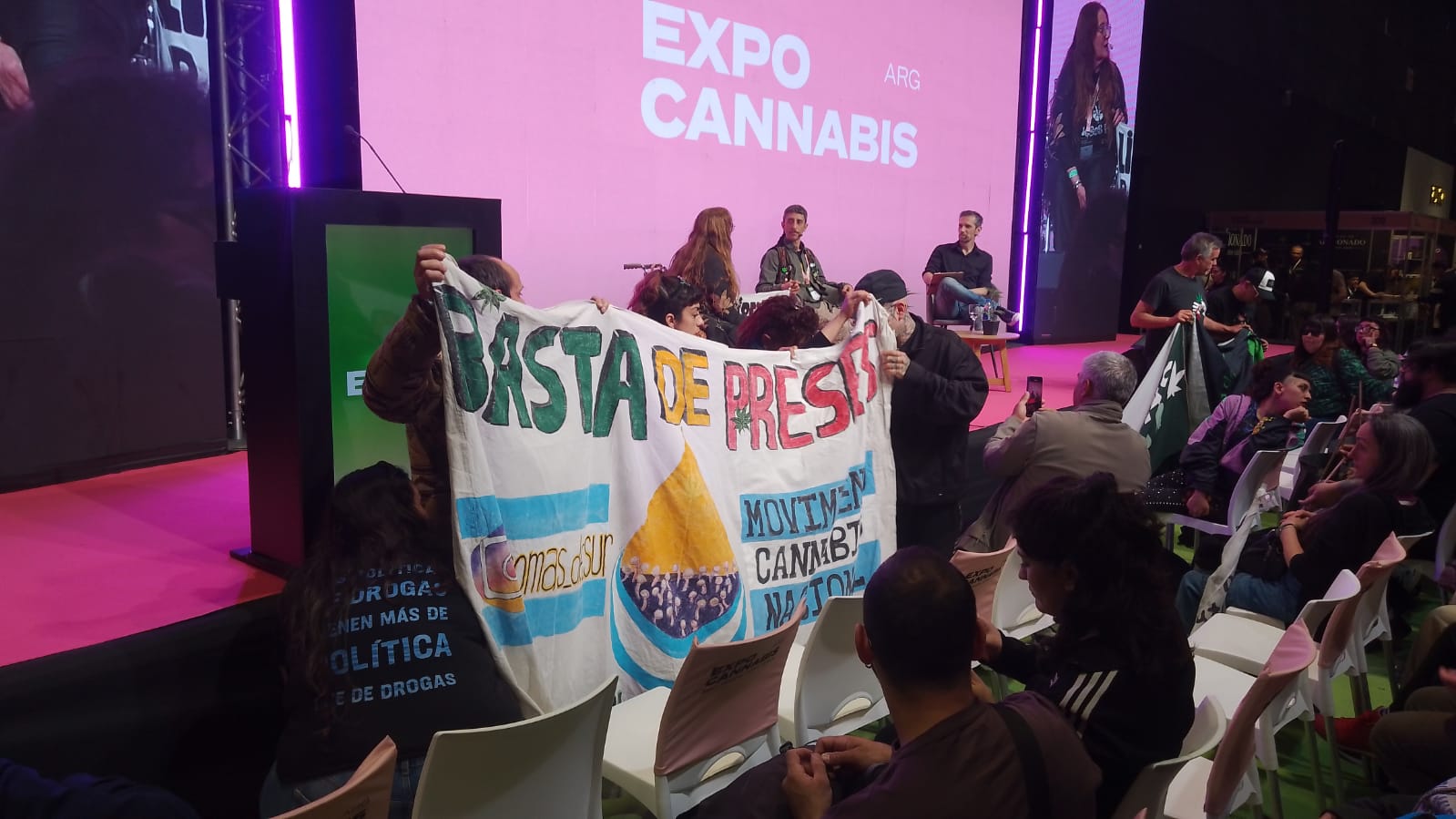
Por eso, junto a amigos de La Rama que Llama que pude conocer personalmente (ya que muchas veces los entrevistamos y hablamos a la distancia), nos invitaron a la intervención final del último conversatorio. Allí se hizo oír el grito de profesionales de la salud, científicos, pacientes, cultivadores, activistas, cooperativistas e industria cannábica al clamor de “No más presos por cultivar”, invitando a la Marcha Nacional de la Marihuana, la reforma de la Ley 23.737 y la apertura de la industria a todos los sectores de la sociedad, con un especial pedido por la libertad de @mari_agunin, quien está presa por 7 gramos de marihuana con una condena de 15 años. ¡Libertad a todas las personas presas por cultivar!
Quiero agradecer especialmente a la organización de la Expo Cannabis 2026 por la consideración, y en particular a Hierros La Quiaca, Revista Hierba, La Rama que Llama y a Tincho de Accuti, quienes hicieron posible este viaje.
Special report from Buenos Aires for La Rama que Llama / Revista Hierba
On my visit to Buenos Aires, after a long trip from Jujuy, I had the feeling of arriving at a great statue of time: unchanging and majestic. As for the purpose of my visit, it was to attend Expo Cannabis 2026, held on October 23, 24 and 25, with confirmed press credentials. I took this as recognition of the years La Rama que Llama has been on the air as a cannabis radio show.
Arriving at La Rural — a huge fairground that hosted Expo Cannabis and, in another area, a classic car show — I found a giant building housing more than 100 stands. There you could find medical and veterinary consultations; hemp showcases with food, textiles and machinery; and the cannabis plant showcase, where each plant was prettier and more fragrant than the last. There was also a wellness area selling health products and a science area presenting the year’s research and discoveries, run by CONICET’s Network for Medicinal and Industrial Cannabis Use (RACME). On top of that, three large stages hosted talks by experts in the field.
Walking through each pabellón — “pavilion,” a slightly odd word they used for the aisles — I could see the industry at work: stands selling grow lights, flowers for people registered with REPROCANN, seeds, hydroponic irrigation systems, organic fertilizers, and all the basic and top-of-the-line gear for consuming cannabis in different ways and with different effects on our health. The place was bursting with people who were already high and people eager to ride the marijuana wave; beyond that, a courtyard gathered all the brands that make up the world of a cannabis user anywhere in the country.
The talks covered a range of topics: other medicinal plants, legal studies and scientific research. The fungi kingdom was there too, with a stand and showcase that was very hard to get into because it was always packed (it is the community’s up-and-coming medicinal alternative).
Then, after a rain that kept threatening, I went out to the open-air courtyard to watch the community unfold before the bulging eyes of the sentinel of the old Sociedad Rural building.
There were flavors, smells and colors of every kind, and the guiding principle was sharing. After passing a stand where attendees were being smudged with incense, we set off across the big courtyard, which held booths from INTA (Argentina’s National Agricultural Technology Institute), a space devoted to autism treatment, the THC tent — with talks on growing and recreational activities — and all the big cannabis-gear brands. These ran games for seeds and merchandise, drawing long lines. The food court had food trucks from big fast-food brands. Worth a mention here is Highlander | Asociación Civil, an NGO from San Luis that filled the lungs of anyone crossing the courtyard with smoke, since its stand ran a nonstop flower tasting.
Science’s Place at the Expo
INTA was there presenting hemp as an ecological, eco-friendly option for construction and fiber. They also laid out the difficulties they face today because of the defunding and dismantling of state agencies, along with the professionals leading research on the plant within CONICET (Argentina’s national scientific research council).
There was an exhibition and awards for research posters in Medical Sciences, Veterinary Sciences, Agricultural Sciences, Legal Sciences and Social Sciences, among others. At the final awards, the presenter noted that the social sciences were among the areas that received the most submissions this year. One caught my attention in particular: a study by the NGO Oeste Cultiva Moreno together with the Moreno Veterans’ Union, titled “Medicinal cannabis and comprehensive health in Malvinas War veterans and their family networks,” by Iara Peralta Brites and Dr. Daniel Fernandez, whom we will cover in another piece. On receiving their awards, every researcher vehemently demanded that the University Funding Law be enforced.
The Ceiling of Prohibitionism
The idea that Expo Cannabis is “the ceiling of prohibitionism” comes from paraphrasing the keynote by Dr. Marcelo Morante, a leading figure in medicine and public policy on cannabis, and the closing talk by Adriana Funaro and Matías Faray, well-known activists in the cannabis community. They were the ones who unpacked the phrase: “Prohibitionism and Narcotics Law 23,737 put a ceiling on the development of the industry, health and science,” since the regulation of access to medicinal cannabis (Law 27,350 and its registry, REPROCANN) has not deeply addressed the real problems facing users, growers and researchers.
You cannot lock everyone up; you cannot keep holding back progress in health, research and industry because of one law. A law that has run over growers, adult users and medical users alike, sparing no one in its enforcement. A law that has handed criminal penalties to people who were seeking relief for their mind, body or soul, or who were trying to make ends meet.
I believe events like Expo Cannabis — and taking them to the rest of the country — represent the ceiling of this law. These spaces allow adults to freely enjoy and use a plant, with quality information, safe access, and scientific advances that show us every day the well-proven medicinal capacity of the plant to treat various ailments of body and soul. They also expose the obstacles INTA scientists face in developing hemp and its by-products, which could well go toward bio-construction and help solve Argentina’s serious problems with access to safe housing. For all these reasons, I believe today that the ceiling on the law is being set by the national cannabis movement, the industry, decriminalization, the legalization of cannabis, and the release and historical reparation of the men and women imprisoned for marijuana.
We must fight as a community, march and demand legalization. REPROCANN is a palliative for this great plague afflicting our plant, called Law 23,737.
That’s why, together with friends from La Rama que Llama whom I finally got to meet in person (since we have so often interviewed and talked with them from afar), we were invited to the closing intervention of the last panel. There, the voices of health professionals, scientists, patients, growers, activists, cooperative members and the cannabis industry rose in the cry of “No more prisoners for growing,” calling for the National Marijuana March, the reform of Law 23,737 and the opening of the industry to every sector of society, with a special plea for the freedom of @mari_agunin, who is imprisoned over 7 grams of marijuana with a 15-year sentence. Freedom for everyone imprisoned for growing!
I especially want to thank the organizers of Expo Cannabis 2026 for their consideration, and in particular Hierros La Quiaca, Revista Hierba, La Rama que Llama and Tincho from Accuti, who made this trip possible.